






Looking to dip your toes into the wholesale accessory market?
Whether you're looking for wholesale fashion accessories or some fun trinkets and doodads, there's a lot to consider.
Many new retailers diving into wholesale accessory markets are a bit overwhelmed. Some feel there are too many options or too many things to consider. Others want more guidance and insight into how to make the best choices.
No matter where you fall, this article is here to help you navigate the wholesale accessory market, choose the right products for your store and customers, and make sure you're only doing business with the best wholesale accessory companies.
What is the wholesale accessory market?
The wholesale accessories market involves buying and selling fashion and lifestyle accessories in bulk, often at discounted prices. Retailers benefit from this model by securing inventory at lower costs, allowing for higher profit margins. Successful participation requires market insights, strong supplier relationships, and effective inventory management.
The wholesale accessory market is the link between the people who make the products (manufacturers) and the people who sell them to you (retailers). Many makers of these cool accessories can't or don't want to deal with tons of tiny orders, so they sell in bulk to wholesalers.
Why tap into the wholesale accessory market?
The wholesale accessory market has been experiencing incredible growth, with projections showing a rise in market volume and revenues across various regions.
- In the United States, the accessory market is projected to grow by 1.01% from 2023 to 2026, resulting in a market volume of $104.7 billion in 2026.
- Globally, the fashion accessory market is expected to see a compound annual growth rate (CAGR) of 12.3% between 2023 and 2028.
- The mobile phone accessories market is forecasted to grow at a CAGR of 6.8% from 2023 to 2033, with its market value expected to reach $189.8 billion by 2033.
- China holds a leading position in terms of revenue in the accessories market, with a record of $98.3 billion.
These figures suggest a strong trajectory for the wholesale accessory market, with mobile accessories and jewelry leading the way. These growth rates indicate a thriving market with opportunities for both new and existing players.
How to buy accessories wholesale
1. Figure out what you need
Start by deciding what wholesale items you're interested in. It could be anything from jewelry, hats, and belts to phone cases, chargers, and headphones.
Pick a style or styles that suit you or your target market. Think modern, vintage, luxurious, casual, or another specific style. Look at listicle articles from popular fashion media companies to get a pulse on what's selling right now, then back it up with finding those products in other stores and looking them up on sites like Google Trends.
For example, you can determine if something is trending by gauging interest. The trend below represents luxury accessories. It shows slight, consistent growth over the past five years, with spikes of interest during the winter months.

As you're conducting your search, keep a spreadsheet of items, links, notes, and any other details that catch your eye during the brainstorming process. This will come in handy later when you're making your final decisions.
💡PRO TIP: Calculate the total cost you are willing or can afford to spend on buying wholesale accessories. Include the cost of goods, shipping, taxes, and any other additional costs.Then, determine your ideal profit margin to help in negotiating prices with wholesalers.
2. Research wholesalers
Use online wholesale directories to find a list of wholesalers dealing in the type of accessories you want. Some popular directories include Faire, Alibaba, and Wholesale Central. You can also source accessories from verified Shopify brands using Shopify Collective, Shopify's built-in product sourcing feature, which lets you browse millions of items and sell them without buying inventory upfront.

When researching wholesalers, consider the following:
- Local versus international. Local wholesalers may offer lower shipping costs and faster delivery. International wholesalers can offer lower product prices. But you'll need to consider factors like shipping costs, customs duties, language barriers, and longer lead times.
- Details. Compare the pricing of products, minimum order quantities (MOQ), and any discount structures for bulk purchases. Understand each vendor's payment terms, shipping costs, and return policies.
- Reviews and testimonials. Look for reviews on independent review sites or on their wholesale website. Or, ask the vendor for testimonials or references from other satisfied customers.
Shortlist a few wholesalers that meet your criteria. Then, contact them to gauge their customer service, willingness to provide information, and to discuss your needs.
You may also want to ask them for things like:
- A copy of their business license and registration
- A copy of compliance certificates
- Proof of registration with any necessary entities
- References and contact info from current customers
💡PRO TIP: If possible, visit the wholesaler's location or trade shows they attend. You can inspect the quality of the products firsthand. Plus, meeting in person builds trust and creates a better business relationship.
3. Place a sample order
Reach out to the wholesaler and ask about placing a sample order. Understand any costs associated with the sample order, including the price per item, shipping costs, and any other fees.
Follow the wholesaler's process to place a sample order. This may involve filling out an order form, creating an account, or contacting a sales representative. Then pay for your sample order and hang tight until it comes.
💡PRO TIP: Thoroughly inspect the sample order products for quality, workmanship, and consistency with the product descriptions. If the accessories have functional aspects, like adjustable straps for a belt, test them to ensure they work as expected.
4. Order your accessory products
Before placing a bulk order, negotiate the price per unit, especially if you are ordering in large quantities. Negotiate payment terms that are favorable for both parties. Common terms might include a deposit upfront, with the balance due upon delivery.
Have a process in place for receiving the bulk order. Be sure to check the shipment against the order form and PO to ensure you're getting the right products. Always inspect the accessories for quality and any damages.
💡PRO TIP: Keep accurate records of the order, including all communications, invoices, delivery receipts, and any issues encountered.
Tips for buying wholesale accessories
1. Understand wholesale accessory market trends
You know that the wholesale accessory market is booming. But it's time to dig a little deeper. Do you understand which types of products are bigger hits among certain audiences and demographics and in which parts of the country?
These are critical connections you need to make if you want your business to be successful. This is called a product-market fit, which is basically how well you've matched your store's accessories to the people you're trying to sell them to.
You can better understand trends by:
- Subscribing to trade magazines and reports related to your market
- Networking with industry peers and going to events
- Attending trade shows and expos
If you maintain a good relationship with wholesalers, and regularly order from them, you can also get insight into new products and trends they are seeing in the market.
2. Find popular products on Faire
Finding boutique accessories can be a whole lot easier than you might think. This is especially true with the development of awesome platforms like Faire. Just do a simple search for accessories or check out the sidebar to shop Faire's extensive inventory of unique wholesale products.
Here's a look at the "Bracelets" section under the "Jewelery" category.
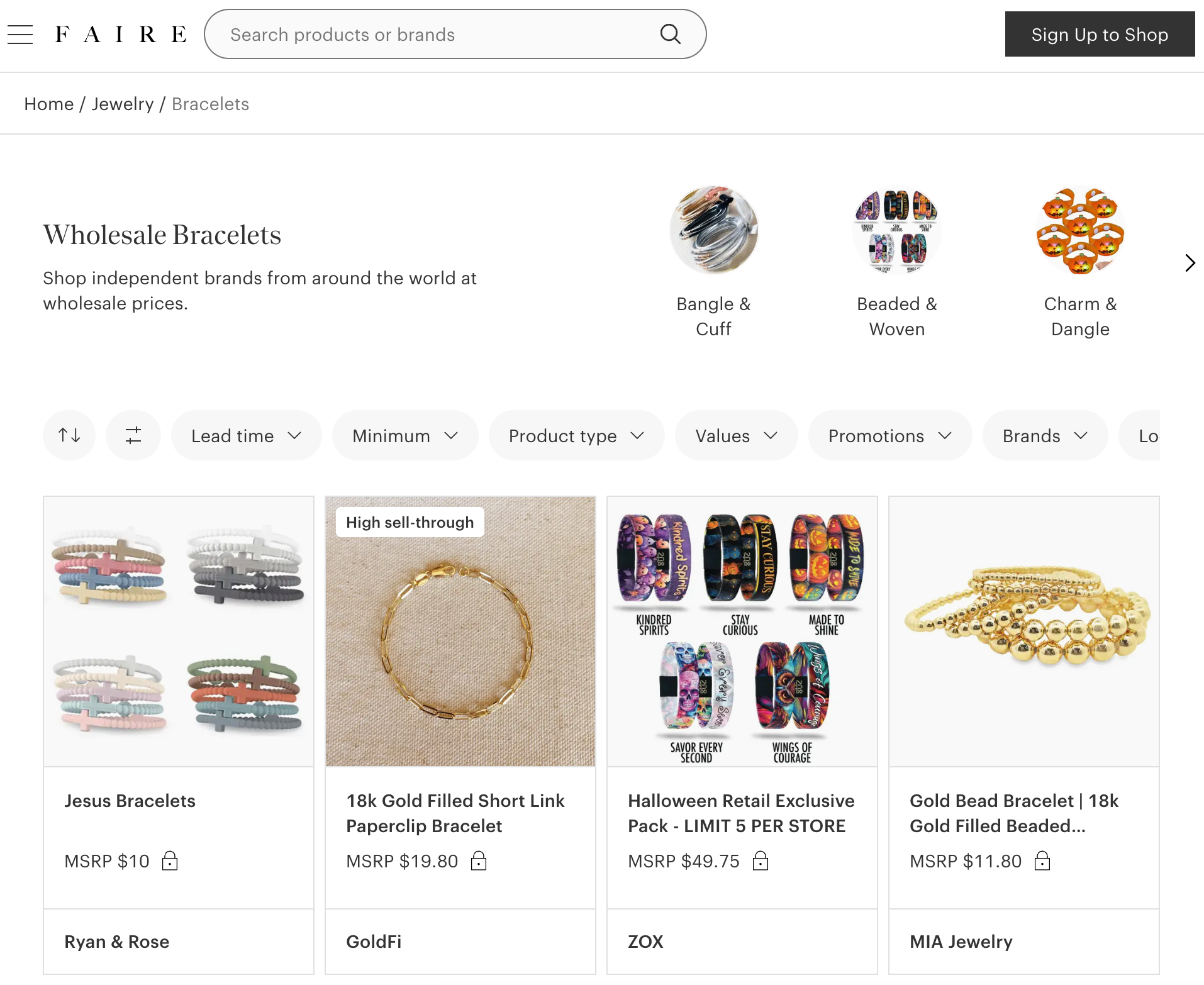
You can search by products or suppliers, as well as drill down your searches, like minimum order value and the location you'd like your wholesale accessories vendors to be based.
This can help massively when it comes to fast shipping and fees like tariffs that you might incur from shipping certain items from out of the state or out of the country.
3. Keep a growth mindset as you plan
Growth is one of the most forward-thinking things to consider before you start working with wholesale accessory distributors. Sure, you don't need too many of any given item before you're positive your store will get off the ground.
But before you know it, you might have more and more customers, which means more orders to fill. It's a bad (and a little bit ironic!) position to be in when your store is growing but your suppliers can't keep up with your customers' demand.
You can potentially protect the future of your business by sticking with wholesale accessories vendors who specialize in the products you're selling.
Alternatively, they might boast large and comprehensive collections on certain types of items so that you know they're ready to ramp up the supply when your demand asks for it.
For example, if you're interested in selling removable patches for snapback hats, consider a company like Pull Patch. That's all it sells, so you know it makes them well and that it's likely able to meet increased orders if demand for these items skyrocket in your store.

Conquering the wholesale accessory market
On the outside looking in, the wholesale accessory market can look pretty intimidating. This is because there are endless ways to get things done, along with a whole lot of considerations you should be making along the way.
But there's just as much opportunity for retail entrepreneurs who do it right.
This is especially true with the US wholesale accessories market, where we're the largest in the world for looking fly and decking out our wardrobe, homes, offices… you name it.
As long as you approach it with a plan and take the time to do your research, there's really nothing stopping you from being the next big thing in the wide world of accessories.
Wholesale Accessories Market FAQ
What is a typical minimum order quantity for wholesale accessories?
Minimum order quantities for wholesale accessories generally range within 1 to 50 units for smaller or newer suppliers, though established brands can set far higher thresholds. Suppliers use MOQs partly because purchasing products in bulk can help ensure retailers are paying the best price possible per unit through economies of scale. Many marketplaces also let buyers combine multiple accessory SKUs into a single order to meet an MOQ without committing to large quantities of one item.
How much should I budget for my first wholesale accessories order?
Budget for the full landed cost of an order — product price, shipping, taxes, and any supplier fees — plus a separate amount to cover a sample order before committing to bulk quantities. Setting your target profit margin before you start negotiating gives you a clear ceiling for what you can pay per unit. Sellers who import internationally often underestimate customs charges and lead times, so get a full written cost breakdown from the supplier before placing a large order.
Are minimum order quantities negotiable with wholesale suppliers?
Minimum order quantities are not always set in stone, and many suppliers are willing to negotiate them for reliable buyers or larger dollar commitments. Some suppliers break MOQ requirements down by style, color, or value, so mixing several designs into one order can help retailers reach a lower threshold. Starting with a smaller trial order and demonstrating you can sell through inventory quickly often earns better terms on future purchases.
What's the difference between buying accessories wholesale and dropshipping them?
Wholesale buying means purchasing inventory upfront in bulk and storing it until it sells, while dropshipping means listing accessories and paying the supplier only after a customer places an order. Wholesale gives more control over pricing, packaging, and shipping speed since stock is already on hand. Dropshipping trades some of that control for lower financial risk, since no capital gets tied up in unsold inventory.
How many wholesale accessory suppliers should a new retailer work with?
Working with two or three wholesale accessory suppliers per product category is a common starting point for new retailers, since it protects against stockouts if one vendor faces delays, raises prices, or discontinues an item. Spreading orders across a few reliable vendors also creates leverage when negotiating pricing or minimum order quantities. Adding too many supplier relationships at once, though, can make quality control and communication harder to manage.


